Proportion Calculator
Enter any three values to solve a proportion for x. You get the exact fraction, the decimal, every cross multiplication step, a ratio table and a graph, all free and with no signup.
Solve a Proportion
Enter any three values and leave one box empty. Get the exact answer, the unit rate, and the steps, with a table and graph where applicable.
Direct: the ratio stays constant. Inverse: the nonzero product stays constant.
Missing value · c
x = 9
3/4 = 9/12
Unit rate
≈1.3333
Each 1 of a matches approximately 1.3333 of b.
Reverse rate
0.75
Each 1 of b matches 0.75 of a.
Scale factor
×3
The second ratio is the first one multiplied by 3.
Simplest ratio
3 : 4
Both ratios reduce to the same simplest form.
Step by step solution
- Write the proportion with x in place of the missing value: 3/4 = x/12.
- Cross multiply. In every true proportion, a × d equals b × c, so 3 × 12 = 4 × x.
- Multiply the two known values on the other diagonal: 3 × 12 = 36. Now the equation reads 4 × x = 36.
- Divide both sides by 4 to get x by itself: x = 36 ÷ 4 = 9.
- Check the answer. 3 × 12 = 36 and 4 × 9 = 36. Both cross products match, so the answer is correct.
Ratio table
| Top value | Bottom value |
|---|---|
| 1 | 4/3 |
| 3 | 4 |
| 6 | 8 |
| 9 | 12 |
| 12 | 16 |
| 15 | 20 |
| 30 | 40 |
Every row has the same ratio. Your values are highlighted.
Graph: a straight line through 0
(3, 4) (9, 12). Across: a and c (top). Up: b and d (bottom).
Try a real example
Your recent calculations
Saved only in this browser. We never see or store your numbers.
Table of Contents
- What Is a Proportion Calculator?
- How to Use the Proportion Calculator
- The Proportion Formula and Cross Multiplication
- Worked Examples You Can Try
- Direct vs Inverse Proportion: How to Tell Them Apart
- Features of Our Proportion Calculator
- Why Choose This Proportion Calculator Over Others?
- Who Should Use This Calculator?
- Common Mistakes When Solving Proportions
- How We Make Sure Every Answer Is Right
- What Users Say
- Frequently Asked Questions
- Start Solving
What Is a Proportion Calculator?
A proportion calculator is a free online tool that finds the missing value in a proportion. You type three known values, leave one box empty, and the calculator returns the fourth value that makes both ratios equal.
A proportion is simply a statement that two ratios are equal. You can write it as a/b = c/d or as a:b = c:d. For example, 3/4 = 9/12 is a proportion, because both ratios simplify to 3/4.
Our tool goes further than a basic solver. It also:
- Checks whether two ratios form a true proportion when you fill all four boxes.
- Solves inverse proportions, where one value goes up while the other goes down.
- Shows the unit rate, the scale factor, a ratio table and a graph for every answer.
- Keeps fractions exact, so 1/3 stays 1/3 instead of turning into a rounded 0.33.
In short, it gives you the answer, the method and the meaning behind the numbers, all in one place.
How to Use the Proportion Calculator
Using the calculator takes about ten seconds. Here is exactly what to do.
- Pick the type of proportion. Choose Direct when both values grow together, like cups of flour and cookies. Choose Inverse when one value shrinks as the other grows, like workers and days.
- Enter any three values. Type them into the boxes for a, b, c and d. Then leave the fourth box empty or type x.
- Add units if you want. Open “Add units” and type labels such as cups and cookies. The answer then reads “x = 5 cups” instead of a bare number.
- Press Calculate. The page smoothly scrolls to your answer.
- Read the steps. Every result includes five numbered steps, a color coded cross multiplication diagram, a ratio table and a graph.
Want to check your homework instead? Just fill all four boxes. The calculator tells you whether the proportion is true. If it is not, it even tells you which value would make it true.
What You Can Type Into the Boxes
The calculator understands numbers the way you write them on paper:
| You type | The calculator reads it as |
|---|---|
| 12 | Whole number 12 |
| 2.5 or 2,5 | Decimal 2.5 |
| 3/4 | Fraction three quarters |
| 1 1/2 | Mixed number one and a half |
| 25% | Percent, equal to 1/4 |
| 1,000 | One thousand |
| x, ? or an empty box | The unknown value |
The Proportion Formula and Cross Multiplication
Every direct proportion follows one simple rule, called the cross product property. If a/b = c/d, then a × d = b × c.
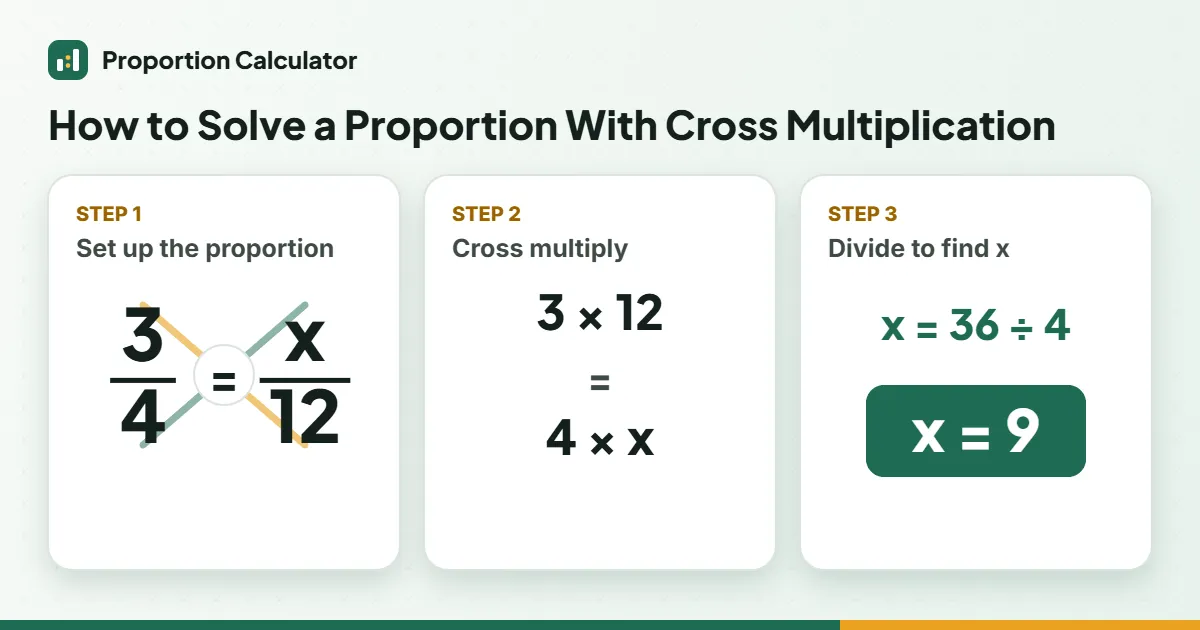
In other words, the two diagonal products are always equal. Mathematicians call a and d the extremes and b and c the means. So you will also hear this rule as “the product of the means equals the product of the extremes.”
Here is how the calculator uses that rule to find each missing value:
| Missing value | Formula | Example |
|---|---|---|
| a | a = (b × c) ÷ d | x/8 = 3/4, so x = 24 ÷ 4 = 6 |
| b | b = (a × d) ÷ c | 6/x = 3/4, so x = 24 ÷ 3 = 8 |
| c | c = (a × d) ÷ b | 6/8 = x/4, so x = 24 ÷ 8 = 3 |
| d | d = (b × c) ÷ a | 6/8 = 3/x, so x = 24 ÷ 6 = 4 |
Why Cross Multiplication Works
Cross multiplication is not a magic trick. Start with a/b = c/d and multiply both sides by b and by d. The b cancels on the left and the d cancels on the right. As a result, you get a × d = b × c.
That is also why b and d can never be 0. Dividing by zero has no answer, so a proportion with a zero denominator does not exist. Our calculator catches this mistake and tells you which box to fix.
The Inverse Proportion Formula
Inverse proportions follow a different rule. Instead of equal ratios, they have equal products: a × b = c × d. This shared product is called the constant, k.
For example, 6 workers finish a job in 10 days, so k = 6 × 10 = 60 worker days. With 4 workers, the job takes 60 ÷ 4 = 15 days. Fewer workers means more days, which is exactly what you expect.
Worked Examples You Can Try
The fastest way to learn proportions is to see them in real life. Each example below matches one of the buttons inside the calculator, so you can load it with a single tap.
Example 1: Scale a Recipe
Two cups of flour make 12 cookies. How many cups do you need for 30 cookies?
Set it up as 2/12 = x/30. Then cross multiply: 2 × 30 = 12 × x, so 60 = 12x. Finally, divide by 12 to get x = 5 cups. The unit rate tells you the same story another way: each cup makes 6 cookies.
Example 2: Read a Map Scale
On a map, 1 inch equals 50 miles. How far apart are two towns that sit 3.5 inches apart?
Write 1/50 = 3.5/x. Cross multiply to get x = 50 × 3.5 = 175 miles.
Example 3: Resize a 16:9 Image
A video is 1920 pixels wide in a 16:9 format. How tall is it?
Write 16/9 = 1920/x. Then x = (9 × 1920) ÷ 16 = 1080 pixels. That is exactly why full HD screens measure 1920 by 1080.
Example 4: Work With a Mixed Number
One and a half cups of rice serve 4 people. How much rice serves 10?
Write 1 1/2 / 4 = x/10. The calculator returns x = 3.75 cups, and it also shows the exact fraction 15/4 and the mixed number 3 3/4. That way, you can measure with whichever cups you own.
Example 5: Solve an Inverse Proportion
A trip takes 3 hours at 60 mph. How long does it take at 90 mph?
Speed and time move in opposite directions, so switch the calculator to Inverse. Then 60 × 3 = 90 × x, which gives 180 = 90x and x = 2 hours.
Example 6: Solve a Percent Proportion
What number is 45% of 80? Percent problems are proportions in disguise. The percent proportion reads amount ÷ base = percent ÷ 100.
So write x/80 = 45/100. Cross multiply to get 100x = 3600, and therefore x = 36. This is the same method that the OpenStax Prealgebra textbook teaches for percent proportions.
Example 7: Check Two Ratios
Do 5/15 and 3/9 form a proportion? Fill all four boxes and press Calculate. The cross products are 5 × 9 = 45 and 15 × 3 = 45. They match, so yes, it is a true proportion. Both ratios simplify to 1/3.
Direct vs Inverse Proportion: How to Tell Them Apart
Picking the right type is the most important decision you make. Get it wrong, and the math still works, but the answer makes no sense.
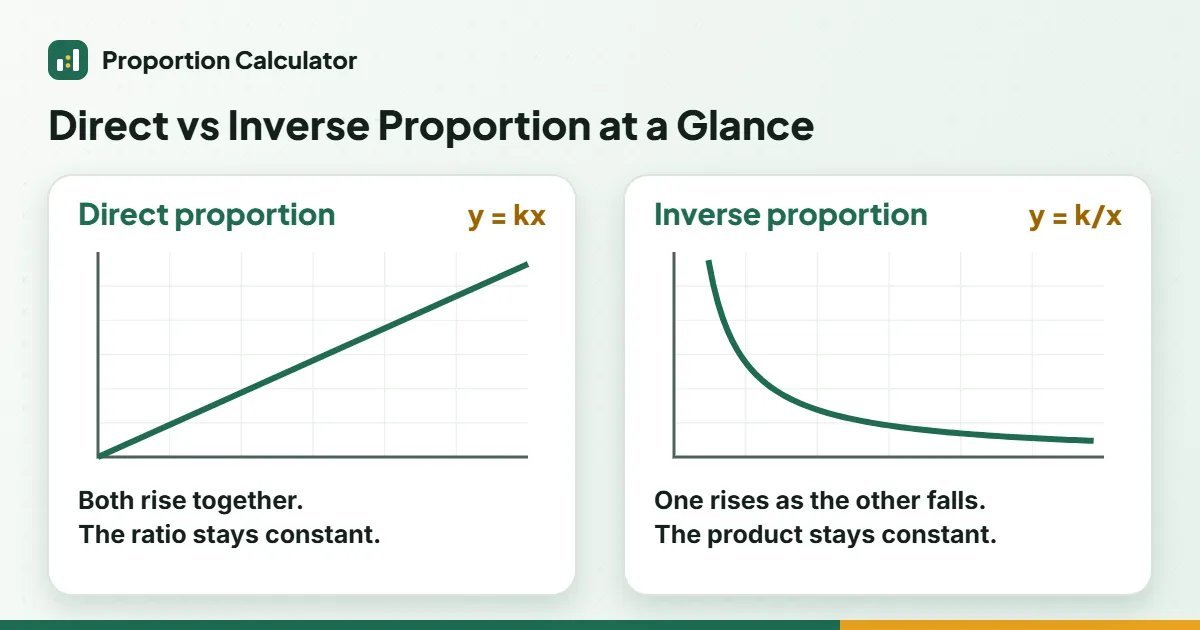
| Question | Direct proportion | Inverse proportion |
|---|---|---|
| What happens when one value doubles? | The other value doubles too | The other value halves |
| Equation | y = kx | y = k/x, or x × y = k |
| What stays the same? | The ratio y ÷ x | The product x × y |
| Graph | A straight line through 0 | A curve that never touches the axes |
| Everyday examples | Recipes, map scales, unit prices, currency exchange | Workers and days, speed and travel time, pressure and volume |
Here is a quick test. Ask yourself, “If I get more of the first thing, do I get more or less of the second?” More and more means direct. More and less means inverse.
These ideas line up with Common Core standard 7.RP.A.2, which asks students to recognize proportional relationships in tables, graphs and equations. That is why our calculator shows all three for every answer.
Features of Our Proportion Calculator
We built every feature to solve a real problem we saw students and teachers struggle with.
- Solve for any position. The unknown can sit in a, b, c or d. You never have to rearrange the problem first.
- Exact fraction math. The calculator works with whole number fractions behind the scenes, so it never suffers from the rounding errors that make many calculators show 0.30000000000000004.
- Repeating decimals, shown honestly. An answer like 2/7 appears as the exact fraction, as 0.285714 with a line over the repeating digits, and as a rounded value.
- Direct and inverse modes. One switch changes the whole method, the steps, the table and the graph.
- Units for word problems. Add labels like miles and hours, and they appear in your answer, your unit rate and your table.
- Unit rate, scale factor and simplest ratio. You get the numbers that teachers ask for next, without extra work.
- Ratio table and graph. See your answer on a straight line through 0, or on an inverse curve.
- Five clear steps. Each solution explains what to do and why, in plain words.
- Proportion checker. Fill all four boxes to test any proportion, and see the value that would make it true.
- Copy and share. Copy the answer, copy all steps for your notes, or share a link that opens with your numbers already filled in.
- Private history. Your recent calculations stay in your own browser, so you can return to them anytime.
- Works everywhere. The tool runs on phones, tablets and computers, with keyboard and screen reader support.
Why Choose This Proportion Calculator Over Others?
Most proportion calculators stop at a single number. However, a bare number rarely helps when you need to show your work, check a recipe or explain the answer to someone else. Here is how our tool compares with what you usually find.
| What you need | Typical proportion calculator | Our proportion calculator |
|---|---|---|
| Unknown in any of the four boxes | Sometimes | Always |
| Fractions and mixed numbers | Rarely | Yes, with exact answers |
| Inverse proportions | Usually a separate tool | Built in, one switch |
| Units in the answer | No | Yes |
| Step by step working | Sometimes | Always, five steps |
| Unit rate and scale factor | No | Yes |
| Ratio table and graph | No | Yes |
| Check if a proportion is true | Rarely | Yes, plus the fix |
| Sign up required | Sometimes | Never |
In other words, you get a calculator, a tutor and a checker in one tool. Better still, it costs nothing.
Who Should Use This Calculator?
Proportions show up in more places than most people expect. So, our calculator helps a wide range of people.
- Middle school students learning ratios and proportional relationships in grades 6 and 7 can check homework and study the steps.
- High school and college students can solve geometry problems with similar triangles, chemistry ratios and percent problems.
- Teachers and tutors can project the tool in class, use the ratio table and graph to explain concepts, and share prefilled links with students.
- Parents can help with homework even if they last solved a proportion years ago.
- Home cooks and bakers can scale recipes up or down without guessing.
- Designers, photographers and video editors can resize images and screens without stretching them.
- Travelers and drivers can read map scales and estimate travel times.
- Small business owners can scale costs, prices and ingredient orders.
One honest note: if you work with medication doses or other high stakes numbers, use the calculator to check your math, and then confirm the result with a qualified professional.
Common Mistakes When Solving Proportions
While building and testing this calculator, we kept seeing the same mistakes. Avoid these six, and your answers will be right far more often.
- Mixing up the order. If you put cups over cookies on one side, you must put cups over cookies on the other side too.
- Mixing units. Never put inches on one side and feet on the other. Convert first, because 1 foot equals 12 inches.
- Using direct when the problem is inverse. More workers finish faster, so time goes down. That is an inverse proportion.
- Rounding too early. Keep fractions exact until the very end. For example, rounding 1/3 to 0.33 in the middle of a problem shifts your final answer.
- Forgetting to check. Plug your answer back in and compare the cross products. If they match, you are done.
- Putting zero in a denominator. A ratio like 5/0 has no value, so it cannot be part of a proportion.
How We Make Sure Every Answer Is Right
You should never have to trust a calculator blindly. That is why we show our work and publish our methods.
- Exact arithmetic. The calculator uses exact fraction math, not floating point shortcuts, so answers like 1/3 and 2/7 stay precise.
- Built on recognized standards. Our definitions follow the Common Core standards for ratios and proportional relationships.
- Tested before launch. We checked the solver against hand worked problems and textbook examples, including tricky cases like zeros, negatives, decimals and mixed numbers.
- Every answer checks itself. The final step plugs the answer back in and confirms that both cross products match.
- Private by design. The calculator runs in your browser. We never see or store the numbers you type.
- No sign up, no limits. Use it as often as you like, for free.
Want the full details? Read How Our Calculators Work and our Editorial Policy. You can also learn who builds Proportion Calculator.
What Users Say
Proportion Calculator is brand new, and we want real feedback, not made up praise. So, instead of filling this space with fake reviews, we are asking you directly.
Did the calculator help with your homework, recipe or project? Did something confuse you? Tell us at proportioncalculator.marketing@gmail.com. With your permission, we will share genuine comments from our first users right here.
Frequently Asked Questions
What is a proportion?
A proportion is an equation that says two ratios are equal, such as 3/4 = 9/12. You can also write it as 3:4 = 9:12. In every true proportion, the cross products are equal, so 3 × 12 = 4 × 9.
How do you solve a proportion for x?
Cross multiply, then divide. Multiply the two known values that sit diagonally across from each other, then divide by the value next to x. For 3/4 = x/12, you get 3 × 12 = 36, and 36 ÷ 4 = 9, so x = 9.
What is the formula for a proportion?
The formula is a/b = c/d, which leads to a × d = b × c. To find a missing value, rearrange it. For example, d = (b × c) ÷ a.
How do I know if two ratios form a proportion?
Multiply diagonally. If a × d equals b × c, the ratios form a proportion. You can also simplify both ratios. If they reduce to the same fraction, they are proportional.
Can I use fractions, decimals or percents?
Yes. You can type fractions like 3/4, mixed numbers like 1 1/2, decimals like 2.5 or 2,5, and percents like 25%. The calculator keeps everything exact until the final answer.
Can this calculator solve inverse proportions?
Yes. Switch to Inverse, and the calculator uses a × b = c × d instead of a/b = c/d. It also shows the constant k, an inverse table and a curved graph.
What is the difference between a ratio and a proportion?
A ratio compares two quantities, such as 3 to 4. A proportion states that two ratios are equal, such as 3/4 = 9/12. In short, a ratio is one comparison, and a proportion is an equation made of two.
What is the constant of proportionality?
The constant of proportionality, k, is the fixed number that links two proportional quantities. In a direct proportion, k = y ÷ x. In an inverse proportion, k = x × y. Our calculator shows it as the unit rate or the constant product.
How do I set up a proportion from a word problem?
Write the same two kinds of quantities on both sides in the same order. For example, cups over cookies equals cups over cookies. Then place the unknown where the question asks for it, and solve.
How do you solve a percent proportion?
Use amount ÷ base = percent ÷ 100. For “what number is 45% of 80,” write x/80 = 45/100. Cross multiply to get 100x = 3600, so x = 36.
Why does my answer have a line over some digits?
That line marks a repeating decimal. For example, 1/3 equals 0.333 forever, so the calculator shows 0.3 with a line over the 3. It also shows the exact fraction and a rounded value.
What happens if I enter 0?
A 0 in the top of a ratio is fine. However, a 0 in the bottom of a ratio has no value, so the calculator highlights that box and explains the problem.
Is the proportion calculator free and private?
Yes. It is completely free, with no sign up and no limits. It also runs in your browser, so we never see or store your numbers.
Can I use this calculator on my phone or in class?
Yes. The calculator works on any phone, tablet or computer. Teachers can project it in class and share links that open with the numbers already filled in.
Start Solving
Proportions do not have to feel hard. Scroll back up, type your three numbers, and let the calculator show you the answer and the reasoning behind it. Then try one of the examples and watch how the ratio table and graph change. Before long, you will spot proportions everywhere, from your kitchen to your next road trip.
Need to simplify a ratio, scale it, split a total or compare two ratios instead? Our ratio calculator handles all of that with the same exact math and step by step working.
Go deeper with our guides
Want to understand the math behind every answer? These guides walk through it with worked examples and practice problems.